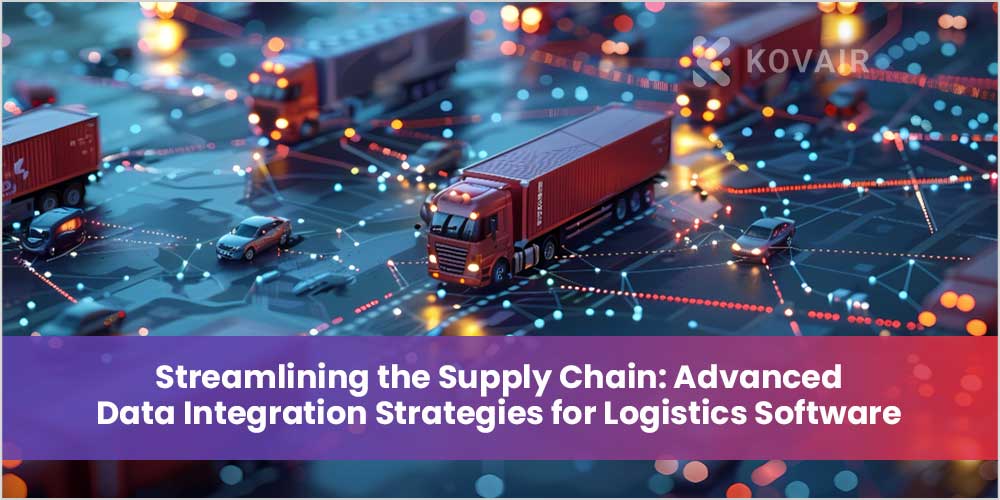
In today’s hyper-connected and rapidly changing global economy, the Supply Chain is a highly complex system with multiple moving parts, from the source of raw materials to the final delivery of the finished product. The flow, accuracy and accessibility of this data are heavily relied on within the Supply Chain. Many businesses will find that this crucial source of information is often fragmented and maintained within siloed systems, resulting in a fragmented, inefficient, and reactive Supply Chain. Furthermore, there has never been a greater demand for supply chain networks to operate with speed, transparency and resiliency, thus creating the need for companies to adopt a transformative way of approaching this issue.
This is where advanced data integration strategies for logistics software can become an absolute necessity. Advanced data integration strategies deliver the key solution to releasing the full potential of logistics operations and provide the ability to transform disconnected data into actionable intelligence. This article will provide an overview of modern integration methodologies and technologies; the benefits associated with the use of such methodologies and technologies; and practical steps for implementing the best integrated methodology and technology available today, thereby allowing companies to optimize their logistics software ecosystems and optimize supply chain optimization opportunities.
Why Fragmented Logistics Systems Slow You Down
Think about how amazing it would be to listen to an orchestra where every musician plays perfectly well together, but has never heard each other before. That is what is happening in many companies when they are trying to deal with “Data Silos.” The data stored in various systems (Warehouse Management System (WMS), Transportation Management System (TMS), Enterprise Resource Planning System (ERP), Customer Relationship Management System (CRM) and many procurement and carrier portals) are often not connected in a way that allows the many systems to work together to share information; there is a real disconnect between the systems.
This fragmentation has enormous consequences. It creates too much manual entry of data, a fertile ground for human error, and tremendous delays in the flow of information. Because of this lack of coordination, inventory accuracy suffers and oftentimes, businesses will have stockouts or excess inventory. Also, missing delivery windows have become commonplace. Most importantly, without end-to-end visibility of today’s supply chains, decision makers are often using outdated information to make decisions instead of current information; therefore, they are forced to react to issues instead of making proactive strategic decisions. Many industry reports point to the huge cost to businesses and operational inefficiencies caused by unintegrated systems, which highlight the urgent need for a unified solution.
Advanced Strategies for Seamless Data Flow in Logistics
Creating a truly fluid & consistent flow of data across organizations requires more than simply linking up systems; it requires taking a data strategy approach to how your data is managed as well.
- Master Data Management (MDM): lies in maintaining consistency among key components of an organization’s systems (e.g., products, customers, vendors) by creating one authoritative version of these data-component entities, thus reducing duplication of data and helping improve the quality of an organization’s data overall and acting as the foundational source for all analytic endeavors.
- Event-Driven Architecture (EDA): Transitioning your logistics organization from a reactive to proactive environment is accomplished through the use of Event Driven Architecture (EDA) to design your systems around event triggered business processes (i.e., when an order is placed, when a shipment is delayed, when the inventory drops below a minimum threshold) and to allow your systems to respond to real-time events, increasing agility significantly.
- Adopting a “Cloud-First” integration Approach: This provides inherent advantages over a traditional systems integration strategy, including: scalability; flexibility; reduced Infrastructure Costs; and easier update policy. While you may still need to utilize hybrid cloud solutions to support your legacy, on-premise systems, the cloud provides a dynamic environment for your new-age logistics software.
- Finally, an appropriate and robust data governance and security framework is mandatory. Establishing well-defined policies, roles and procedures for the compliance and protection of data is critical to protecting sensitive information within your supply chain.
Leveraging the Potential of Analytics and New Technologies Via Integrated Data
The potential of advanced data integration derives from the combination of integrated data being leveraged through analytics and new technologies.
- Predictive Analytics: uses a combination of past and current data to accurately predict demand, as well as plan for possible delays, improve delivery routes and optimize inventory management to be less reactive.
- Artificial Intelligence (AI) and Machine Learning (ML): These technologies have extensive uses in Logistics, such as automating decision-making, detecting anomalies, pricing dynamically and automating intelligently in warehouses that lead towards efficiencies never achieved before.
- IoT Integration: By bringing the real-time physical world into the digital realm using IoT devices with sensors installed on their assets, vehicles and warehouses, companies gain access to continuously updated information (in terms of location, temperature, humidity and condition of the assets) that enables more effective tracking and preventive maintenance of those assets.
- Using Blockchain Technology to Drive Supply Chain Transparency: By providing a secure, distributed ledger that creates secure, immutable records of transactions and movements throughout the supply chain, blockchain has the potential to create trust between supply chain partners, improve traceability throughout the supply chain and minimize or eliminate fraud in complex global supply chains. Together, these integrated data technologies are fundamentally changing logistics to be optimized, data-driven organizations.
Roadmap for Advanced Data Integration Implementation Strategy
To successfully execute an advanced data integration roadmap, you must first develop a detailed plan of action that includes:
- Assessment & Planning: Start with an audit of your current systems, mapping out your existing data flow, and creating defined integration objectives (i.e., see more clearly; decrease operational costs). Integration priorities should be determined based on potential business-related impact.
- Choosing the Right Tools: Choose appropriate tools for integrating data, such as iPaaS, API Management and MDM, that meet your organizational needs, complement your existing technology stack and align with the various types of systems you are integrating. For complex or custom integration requirements, partner with an experienced provider of logistics software development services that has experience developing custom software for integration purposes.
- Phased Implementation: The “big bang” approach is not advisable in data integration; therefore, implement your integrations as a series of smaller pilot projects that can demonstrate value, then be expanded.
- Data Quality & Governance Focus: Data integration is an evolving process that must be approached with a continuous focus on quality initiatives and on compliance with governance regulations.
- Organizational Alignment & Change Management: Address the human element of integration; promote collaboration among functions, provide proper training to employees and proactively manage resistance to change.
- Continuous Monitoring & Optimization: Continuously monitor and assess performance of data integrations, identify areas of potential resistance, and continuously improve data flows based upon changing requirements within the organization.
Final Thoughts
As we’ve discussed, today’s supply chain requires a major change from the fragmented systems we currently have to a fully integrated logistics ecosystem. Companies must use advanced data integration techniques, not just as optional tools, but as a crucial element of their strategic plan in order to provide themselves with greater efficiency, resilience, visibility and competitive advantage over other organizations.
A united front defines the future sustainability of business-to-business (B2B) supply chains; they will need strong strategies to develop an agile, responsive system for the multitude of challenges presented by the B2B environment. To do this successfully, companies must evaluate their existing level of connectivity within their supply chain(s) today and develop plans to create a comprehensive roadmap toward an enhanced next-generation connected, integrated supply chain.


Mila Rowe

Mila Rowe is a technology writer passionate about digital transformation, AI, and enterprise innovation. She simplifies complex ideas into actionable insights for modern businesses.