
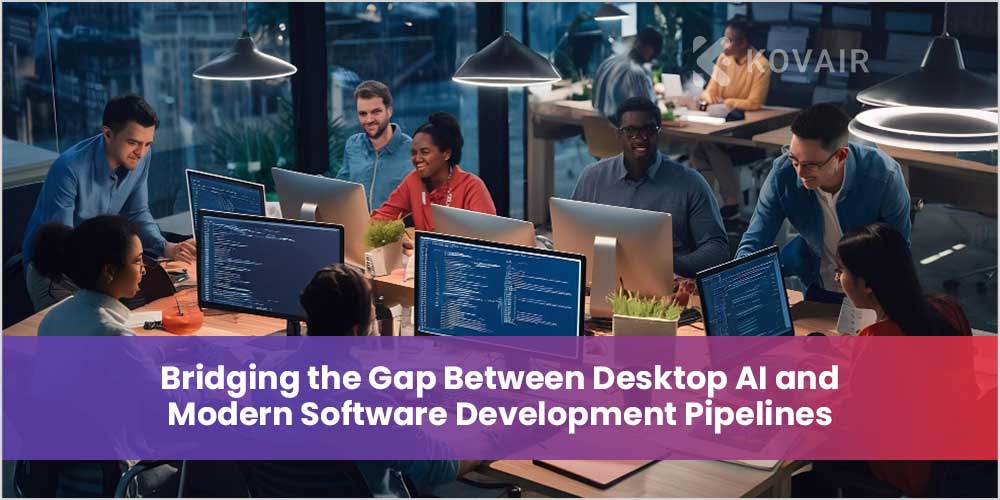
You have spent months tuning prompts. Your team commits code faster than ever. The pull requests arrive like breaking waves, and somewhere, in the cloud, models you cannot see are generating functions you never wrote. It feels like velocity.
But still. You keep discovering the same quiet failure: the code works, but it does not fit. It passes tests, but violates patterns. It was generated, reviewed, and merged – all within your pipeline – yet somehow the pipeline itself became a sieve.
The gap you thought you bridged remains open. Not between human and machine, but between desktop AI- intelligence within the operating system itself – and the living system of standards, context, and intent that makes software actually maintainable.
This is not a story about replacing tools. It is a story about translation.
The Intent Gap: What AI Sees vs. What the Enterprise Means
Here is the problem most teams refuse to confront. Your AI assistant does not understand what your applications are for. It sees functions. It does not see workflows. It can invoke ViewInstrument and GetPortfolio independently, but it cannot infer that a user asking to “review a client’s holdings” needs both, in sequence, with data migrating cleanly between them.
We trained these models on the public internet, not on your institutional logic.
The early response was to expose everything. Every FDC3 intent, every API endpoint, every tool—thrown at the model like dice. And the model, being literal-minded and eager to please, chose randomly. Different results every time. Missing steps. Hallucinated parameters. A magic eight ball where your deployment pipeline should be.
The solution is not more tools, but fewer, better-defined ones.
Composite Intents: When Less Becomes More
Traditional software engineering worships the atomic unit. Small functions. Single responsibilities. This is wisdom for humans, but poison for machines.
Your AI does not need forty individual actions. It needs four composite workflows, each representing a complete user journey. AnalyzeClientPortfolio, not ViewInstrument plus GetPositions plus ViewChart plus guesswork.
This is counterintuitive. It feels like you are hiding your capability. In truth, you are revealing intent.
When Microsoft built Athena, their internal agent for thousands of engineers, they did not give it a menu of every possible Azure DevOps operation. They gave it semantic forms for the work people actually do: pull request lifecycle management, release readiness tracking, security review nudges. The agent does not guess. It knows. Because someone decided, deliberately, what knowing should look like.
Why Your AI Keeps Forgetting
You have noticed something else. Your AI is amnesiac. It reviews a pull request today as though it has never seen your codebase before. It flags the same non-issue it flagged last week. It forgets the architectural decision you recorded in the very ticket it is meant to be analyzing.
Don’t think of it as stupidity when it’s more like statelessness.
The leading edge of enterprise AI deployment is no longer about better models. It is about persistent context.
For instance, Qodo’s platform, currently in beta, continuously indexes your multi-repository architecture, your pull request history, your previously accepted review comments, and your organizational standards—not to replace human reviewers, but to ensure the AI’s feedback evolves with your team’s preferences.
Recent developments in academia take a similar approach. It’s been shown, for example, that FAISS-based memory in multi-agent systems cuts down on redundant feedback while maintaining its core corrective functions.
The Integration Fallacy: You Cannot Bolt Intelligence onto Fragmentation
Here is where many organizations make their most expensive mistake. They buy a coding assistant here, a code review agent there, a chatbot for documentation, and a separate tool for security analysis.
Each works in isolation. None shares context. The developer toggles between browser tabs, copy-pasting error messages, and manually reconciling advice from five different AI systems that cannot speak to one another.
This is technical debt with better marketing rather than an AI strategy.
A promising approach by the company HERE might be instructive. Rather than proliferate disconnected AI touchpoints, HERE embeds intelligence directly into the desktop environment through a controlled execution layer.
The AI receives a permissioned, accurate understanding of the user’s workspace. It can act across applications using the same FDC3 intents and Model Context Protocol that already power human workflows.
The principle is simple: do not build new silos. Extend the ones you already trust.
The Review Paradox
The bottleneck has shifted. It is no longer writing code. It is validating that the code is correct, secure, and aligned with the architecture you cannot expect a language model to intuit.
It’s a clear fork in the road: either you scale code review to match AI development velocity, or quality gates become the constraint that limits competitive advantage.
The solution is not to abandon review, but to make it intelligent.
Spec Kit, GitHub’s open-source methodology, addresses this by grounding the entire development lifecycle in a project constitution—a codified set of architectural principles that the AI must obey. When the agent cannot implement a function cleanly, it inserts a [NEEDS CLARIFICATION] marker rather than guessing. It builds tests first. It checks its own work.
This is not vibe coding. This is engineering with a literal-minded partner who has finally been given instructions that cannot be misinterpreted.
Wrapping Up
You will notice a pattern across every successful deployment cited here. None required custom, one-off integrations between each AI tool and each enterprise system.
You cannot prompt your way out of fragmentation. You cannot fine-tune your way out of context loss. The gap between desktop AI and your development pipeline is not a model problem. It is an architecture problem.
The future of software development is not autonomous agents operating without oversight. It is collaborative intelligence, grounded in shared standards, persistent memory, and the deliberate design of what machines are allowed to assume.
You have built remarkable velocity. Now build the bridge that makes it sustainable. Not with more code. With more intention.
Mila Rowe

Mila Rowe is a technology writer passionate about digital transformation, AI, and enterprise innovation. She simplifies complex ideas into actionable insights for modern businesses.
I completely agree with your point on digital transformation.