
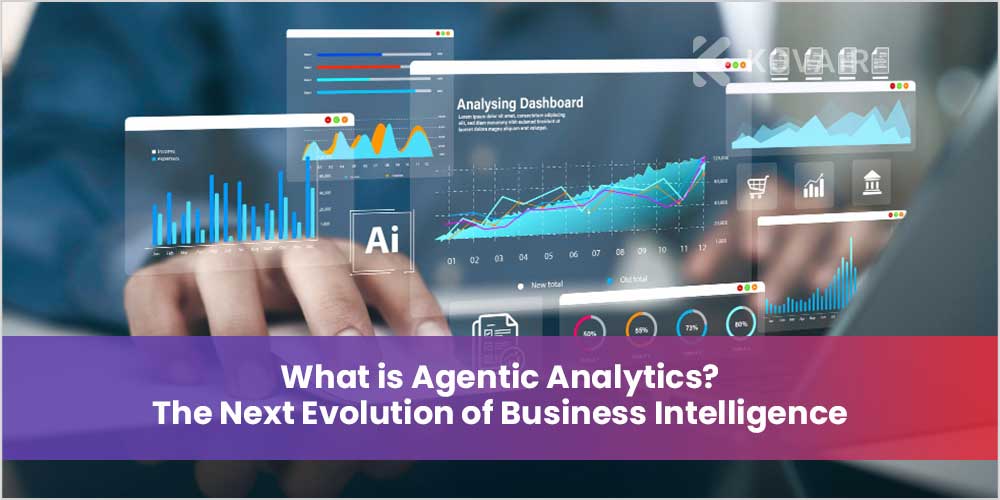
The goal of Business Intelligence (BI) has been the same for decades: to turn data into useful information. However, getting there has often felt like pulling teeth. Even with new dashboards and self-service tools, people still have to do all the work of analysis.
Before you can do anything, you need to know what questions to ask, what filters to use, and how to read the visualizations that come up.
This is where the Agentic Analytics comes in
We are leaving behind the time of static charts and entering the time of AI Agents. These are digital beings that can think for themselves, analyze data, and act on what they find. The change is from tools that show to agents that do.
The Change: From Reactive to Proactive
We need to look at the history of data tools to understand Agentic Analytics.
- Traditional BI (What It Is) – Reporting on the past. On Monday, you check a dashboard to find out why sales fell on Friday. It only reacts.
- Augmented Analytics: The Reason – The start of machine learning. Tools began to point out strange things or suggest connections. It helped people figure out the “why,” but a person still had to drive the car.
- The Do of Agentic Analytics – This is the next big thing. Agentic systems can act on their own. They work with a goal-oriented mindset. If you tell an agent to keep customer churn below 5%, it does not wait for you to look at a dashboard. It monitors live data, identifies at-risk accounts, and examines how they are being used. They might also draft a personalized retention email for your approval.
How Agentic Analytics Works: The Four Pillars
Traditional BI is like a library where you have to know what you want and go looking for it. Agentic Analytics, on the other hand, acts more like a researcher who’s always digging, always connecting dots. This big leap comes down to four key components:
- Perception (The Sensory Layer) – Instead of just sitting there waiting for someone to ask a question, an agentic system stays switched on. It “listens” through live data streams, APIs, and logs. It does not just notice a number; it gets the story behind that number and all the little details in the bigger business picture.
- Reasoning (The Cognitive Engine) – Here’s where things get smart. Agents use Large Language Models (LLMs) and special reasoning algorithms to turn complicated business goals into doable to-do lists. Say conversions drop, an agent does not stop at pointing this out. It knows to check website speed, marketing tweaks, and what competitors are charging, all at once.
- Memory (Contextual Awareness) – Agents remember stuff. They keep track of the conversation at hand (short-term), but they also hold onto what’s worked before (long-term). So, if a certain problem happened last quarter and a discount code fixed it, the agent recalls that and gets smarter every single time.
- Action (The Execution Layer) – This is where things really get agentic. Agents do not just watch and advise; they actually do things. Through tool-calling, they can poke into SQL databases, fire off Slack messages, create Jira tickets, or tweak your Google Ads budget. You get results, not just reports, and you do not have to step in every time.
Building Agentic Analytics with AI Factory
Agentic Analytics turns raw data into autonomous actions. By combining reasoning models with live data availability, organizations can create “AI Factories” that actively resolve complex business issues without requiring constant human involvement.
The Brain: Reasoning Model
The reasoning model is the brain of the operation, processing complex human intent and converting it into logical action.
This is not just predictive text; it is an assessment. It decides what series of actions is best to accomplish a goal.
- Goal Decomposition – Decomposes high-level goals into simple actions.
- Self-Correction – Recognizes flaws in logic and adjusts course.
- Logic Chaining – Links unrelated data points into a logical whole.
- Hypothesis Testing – Tests different hypotheses to determine the most effective course of action.
Memory and Vector Storage
One of the core parts of Agentic analytics is memory and vector storage. It is the reason agents retain context. This storage has all the historical interactions and company knowledge stored in it which can be retrieved in the future as per the company’s requirements.
- Semantic Indexing – Ensure the data is organized by conceptual meaning and not just by keyword
- Long-Term Persistence – Its role in the storage is to recall user preferences and all the previous project details
- Context Window Management – This part prioritizes all the information relevant to the current tasks
- Knowledge Retrieval – Based on requirements, it pulls specific facts and data from massive and unstructured data quickly to prevent the operation from slowing down
Data Access and Querying
This section links the brain to the body. This section offers a way for agents to connect to live databases and APIs.
This section enables agents to retrieve live numbers. This section connects natural language and technical data structures.
- Text to SQL – Uses natural language processing to create accurate SQL requests based on simple questions or commands.
- API Integration – Connecting to other software applications such as CRMs or ERPs for seamless operations and flow of data.
- Dynamic Filtering – It filters live data streams to find particular anomalies.
- Data Security – The major role of this section is to ensure that the agent only accesses authorized data.
Agent Implementation: Assistants and Structures
This is the framework in which the agent is defined. This framework will determine how individual assistants will work together to solve complex problems.
The structural design will determine if the agent works alone or works with a digital team of specialized assistants.
- Role Specialization – This will determine if there is a specialized agent, such as a Financial Analyst agent.
- Tool-Calling Protocols – Identifies if the agent has permission to use specific software tools and grants permission to use them.
- Multi-Agent Orchestration – This section defines how communication will occur among specialized AI entities.
- Standard Operating Procedures – Its role in the Agentic analytics system is to determine the parameters for agent behavior.
User Experience
With the emergence of Agentic Artificial Intelligence, business workflows are changing, and one major change has been noticed in user experience.
Now, we don’t look at the charts anymore because it is now more about chatting with partners. The system focuses on transparency and collaborative decision-making.
Agentic AI has a UX that emphasizes trust, which allows humans to monitor how an agent thinks before it makes the final decision.
- Conversational Interface – It is the interface that humans interact with. Here, complex data is accessed using natural language.
- Reasoning Transparency – This part of the system visualizes the steps that AI agents took to reach the result.
- Human in the Loop – To make the AI agents remain relevant, this feature creates checkpoints for human approval on critical actions.
- Proactive Notifications – This section alerts users about insights before they even request them.
AI Observability
Observability is the quality control of the AI factory. Observability monitors the health, correctness, and cost of the agent operations.
Monitoring tools help the system avoid going off the rails. Monitoring tools ensure all the operations performed by the system are traceable and justifiable.
- Trace Logs – Keeping a record of every thought and action performed by the agent.
- Hallucination Detection – Identifying the agent’s thought process when it generates incorrect data.
- Latency Tracking – Tracking the speed at which the agent answers complex queries.
- Cost Attribution – Tracking the cost of tokens used in the AI operations.
Final Thoughts
Agentic AI is the next evolution of artificial intelligence that won’t need much human command to perform actions. The biggest beneficiary of it will be enterprises as it can streamline operations, reduce unexpected costly maintenance, and more. With it, data becomes more accessible even if it is present in an unstructured form. Business Intelligence is going to become more intelligent with Agentic AI.
Mila Rowe

Mila Rowe is a technology writer passionate about digital transformation, AI, and enterprise innovation. She simplifies complex ideas into actionable insights for modern businesses.