
Kovair Requirements Management
Collaborate, review and manage requirements efficiently across software development lifecycle
Find How


Introducing Kovair Requirements Management
Kovair Requirement Management is a feature enriched solution that can effectively gather, parse, track, and manage various types of requirements effectively. It also supports features like traceability, base lining, and intelligent reporting through a process-driven methodology that enable project teams to seamlessly collaborate on the requirements at a faster speed.
Kovair Requirement Management helps to track coverage as well as establish relationships between requirements, use cases, test cases, defects and other related ALM items to achieve compliance and assuring on-time and better-quality delivery.
Download Requirements Management brochure to get an overview of Kovair offerings
Download Brochure
Key Highlights of Kovair Requirements Management
- Unified web-based platform with hierarchical-based folder structure to achieve single source of truth.
- Advanced parsing methods of requirements from Word documents.
- Review Module for capturing feedbacks from stakeholders requirements.
- WYSWYG Report Designer for creating reports that can be viewed online and in real time.
- Generate Word reports in compliance to different standards.
- End-to-End traceability ensuring visibility of functional, test, and other relational coverages.
- Controlled change management along with version history and impact analysis.
- Built-in Task Based Workflow Engine with visual drag-and-drop workflow designer to support workflows.
Immediate Business Benefits
- Develop a Unified Requirements Management System
- Gather Requirements from Multiple Sources
- Import Requirements from Word documents
- Enrich Requirements with Detailed Specifications
- Organize Requirements in Folders and Sub Folders
- Maintain Version and Change history for audits
- Achieve Real-Time Collaboration with Different Stakeholders
- Draw Prototypes / Wireframes with Built-In Modelling Capability
- Review Requirements in a Collaborative Manner
- Ensure Compliance through End-to-End Traceability
- Automate Requirements Management Workflow
- Manage Requirements with Ease
Live Product Demo with our Experts
Request a DemoMajor Capabilities
Develop a Unified Requirements Management System
Perform Requirements Management processes in an integrated tools environment. Integrate requirement artifacts with other ALM functions such as design, coding, Testing and defect tracking. Kovair’s ESB based Omnibus Integration Platform allows integrations with more than 110+ tools from various IT, ALM third party and open source vendors. Learn more

Gather Requirements from Multiple Sources
Kovair allows the stakeholders to collect requirements from multiple sources using the following mechanisms —
- Import from MS Word or Excel format documents.
- Parse details from email contents.
- Connect to corporate websites through web APIs.
- Integrate with other legacy tools.
- Integrate with MS Outlook.
- Direct entry into the Kovair Requirements Management application.
Automate Requirements Management Workflow
Use Task based workflow in contrast to State based workflow. Facilitate complete automation of Requirements Management workflow through built-in Omniprocess Workflow Engine of Kovair. Draw and define multiple independent processes at different levels through visual drag and drop designer.

Import Requirements from Word documents
Import requirements from Word documents using either the add-in technology of Kovair or by parsing the contents by uploading documents directly into the application. Kovair Smart Parsing Logic allows you to import everything from text, graphics, and even comments. The built-in Word Import feature also allows parsing of requirements using appropriate parsing logics depending on the format in which the contents are present in the document.
Learn more
Enrich Requirements with Detailed Specifications
Decompose Requirements into use cases. Define user-defined artifacts and attributes to track and manage various type of requirements as per the business needs. Generate specification document adhering to different standards using the Kovair Word add-in component for MS Word.

Organize Requirements in Folders and Sub Folders
Kovair supports hierarchical folder structure consisting of various folders and sub folders that can be created for grouping requirements and arranging those in an organized format. Along with this, Kovair aims to make data management and tracking more advanced as well as user-specific.

Maintain Version and Change history for audits
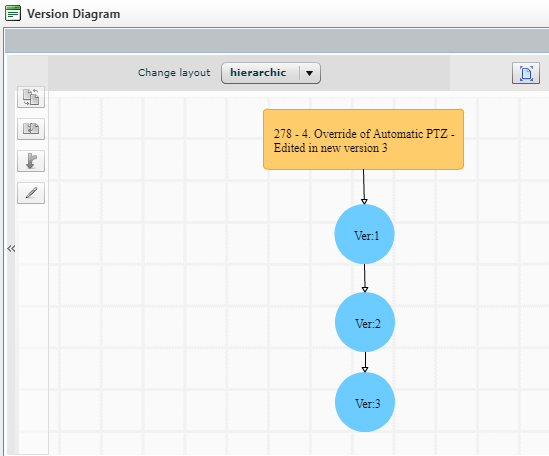
Versioning of Requirements
Kovair treats versioning of requirements at a much granular level. Users can opt for versioning whenever a requirement is modified, or it can be done based on user judgement. Kovair allows side-by-side comparison between the two versions of requirements, as well as rollback to a previous version, as and when needed. Requirements can be reconstructed from the previous version as well.

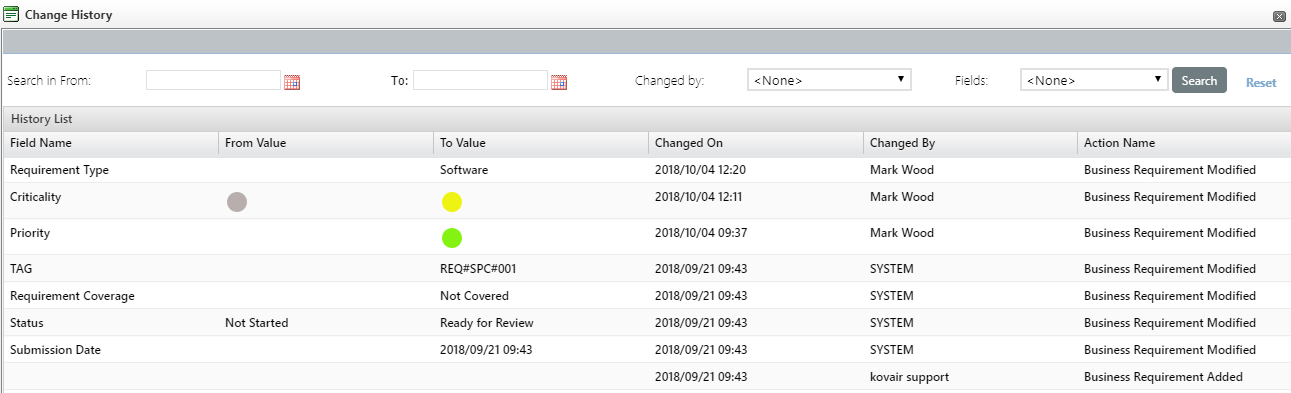
Track Changes Made in Requirements Via Change History
Maintain change history of different attributes of requirements and get answers to audit related queries for a change like the name of the reviewer, detail list of the changes that have been made, and the date on which the changes have been made.
Achieve Real-Time Collaboration with Different Stakeholders
As project goals and deliverables are shared by diversified teams, ensuring proper collaboration among all is a must for managing Requirements, either locally or globally. Kovair effectively addresses the above and provides a unified platform where globally distributed teams can collaborate to work on requirements in real-time across disparate multi-vendor tools.
-
Benefits to be listed as follows:
- Avail precise tools for efficient management of requirements
- Empower stakeholders with insights into the delivery progress.
- Embrace collaboration among cross-functional team members.
- Complete visibility on functional coverage of Business Requirements, Test Coverage of Functional Requirements, and Use Case Coverage of Business Requirements.
- Assured regulatory compliance and quality output.
- Reduced delay of review feedbacks and approvals from various stakeholders.
- Informed analysis of coverage reports to identify gaps throughout the lifecycle and undertake corrective measures accordingly.
- Requirements management support for all domains.
Draw Prototypes / Wireframes with Built-In Modelling Capability
Elaborate requirements through appropriate functional representation by drawing and embedding various types of diagrams like Use Case Diagrams, UML Diagrams, Flow Charts, UI Mockups, BPMN Diagrams, as well as Generic Diagrams.
Learn more

Review Requirements in a Collaborative Manner
Invite all stakeholders to review, discuss, and decide on the requirements and refine the list of requirements to work upon. Initiate and participate in ad hoc discussion threads and accelerate the decision-making cycle to a faster pace. Subscribe to get notified on any change in requirements based on feedbacks received. Share contextual information about software specs.
Ensure Compliance through End-to-End Traceability
Stakeholders working on requirements need to manage the changes occurring in various phases of the development lifecycle in order to ensure both impact analysis and quality improvement. They always track information at a granular level and quickly assess the direct and propagating impacts, whenever a new version of a requirement is created or any request for change or enhancement have been raised and linked to one or multiple requirements.
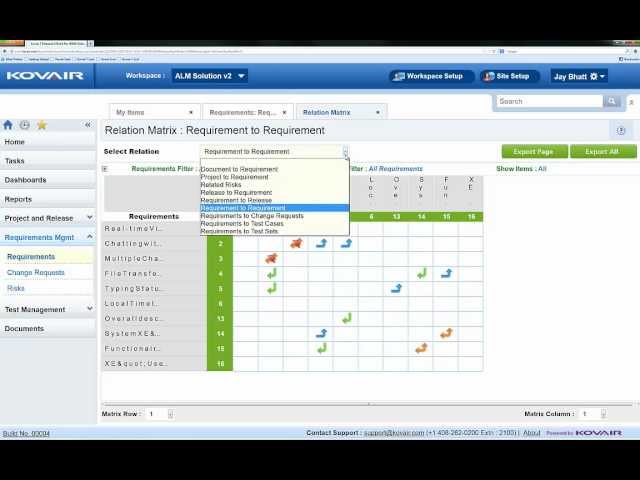
- View Relation diagrams and relation matrix to ensure every requirement, system and components specifications have been covered and tested.
- Define relationships between requirements and other lifecycle data.
- Configure and customize your traceability diagrams.
- Create, maintain, relate, validate and verify product specifications in a single place.
Manage Requirements with Ease
Users who have been managing their requirements in standalone word documents or excel spreadsheets can now take the advantage of tracking and managing their requirements from a secure, central, and accessible location. Teams working from different geographical locations as well as cross functional teams can now work on a single source of truth and no productivity is lost in working on incorrect information or waiting for unavailable piece of data.

Resources
Refer to our library of brochures, case studies, white papers, blogs, datasheets, and more