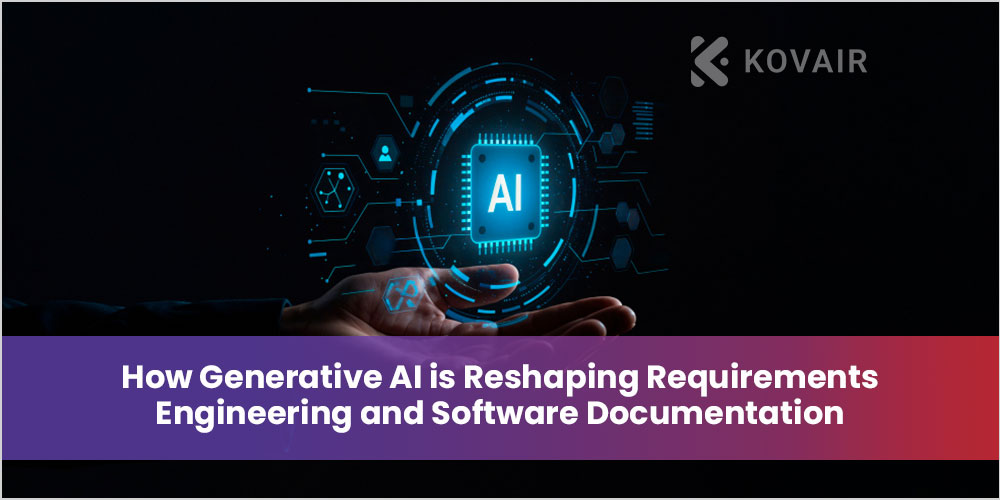
Bridging the gap between messy business demands and precise technical specs has always been the single biggest headache in application lifecycle management. User stories get lost in translation. Functional requirements go stale. Before long, scope creep hits – and expensive late-stage rework follows right behind it.
That cycle is finally breaking. Generative ai in requirements engineering will revolutionize the way engineering teams document, audit, and establish baselines for software requirements. The requirements documentation process is no longer secondary; engineers can convert unstructured stakeholder inputs into structured specifications.
Streamlining Requirements Capture Across ALM Toolchains
Balancing business targets against technical debt isn’t easy. Analysts spend weeks drafting SRS (Software Requirements Specifications), hunting for edge cases, and manually checking whether Jira stories match up with legacy databases or Azure DevOps pipelines.
Modern ai application development platforms change this equation. By ingesting raw meeting notes, client briefs, and user feedback, these tools generate structured user stories complete with standardized acceptance criteria. The impact of integration in the context of enterprise integration platforms and orchestration layers will be seen almost immediately when the technologies get connected-
- Automated Gap Identification- LLMs (Large language models) scan draft specifications to spot ambiguous phrasing, missing boundary parameters, or conflicting business logic long before developers write a line of code.
- Bi-Directional Traceability Generation- Systems map high-level business goals directly down to functional specs, architecture components, and unit test suites.
- Instant Baseline Storyboarding- AI engines convert text feature descriptions into visual user flows during initial discovery calls.
The result? Product teams validate clean, conflict-free requirements in hours rather than spending weeks stuck in review meetings.
Living Documentation – Overcoming Tech Debt and Knowledge Silos
Here’s a familiar reality – codebases move fast during active sprints, but internal documentation stays stuck in the past. Repositories change daily. Architecture decision records don’t. That disconnect breeds technical debt and turns regulatory audits into a scramble.
Rethinking Documentation Lifecycles – Traditional Manual vs. AI-Driven ALM
The table below compares static manual documentation against self-updating, AI-assisted engineering assets.
| Metric | Traditional Manual Process | AI-Driven Execution |
| API Reference Maintenance | Written post-release – frequently misses endpoints | Auto-updated from source code on every build |
| Edge-Case Coverage | Dependent on individual analyst thoroughness | Systematically flagged by AI models during spec reviews |
| Impact Analysis & Audits | Manual tracking across disconnected tools | Real-time AI mapping of code changes to initial requirements |
| Developer Onboarding | Digging through scattered, outdated wikis | Conversational querying via repository-trained AI agents |
Adopting generative AI development services turns static wikis into living, self-maintaining ecosystems. Modern tools parse abstract syntax trees inside CI/CD pipelines, updating developer guides and test plans the moment pull requests merge.
By embedding custom AI solutions into core repositories, technical teams drop the administrative weight of manual documentation while keeping architecture guides completely aligned with active source code.
Protecting Domain Knowledge in Enterprise Environments
When senior developers leave, the critical knowledge about the system often leaves with them. For enterprises with complex legacy stacks, that risk is not acceptable.
Enterprise ai development tools address this by training models on proprietary repositories, internal decision logs, and past bug tickets.
Industry data shows that automated technical drafting can boost engineering throughput substantially, enabling senior architects to concentrate on high-value system design work instead of routine documentation updates.
These context-aware tools are internal knowledge stores. When a new developer joins a project, they can ask natural language questions about complex system dependencies and receive instant, accurate answers supported by active requirements and code files.
Human Monitoring in AI-Powered Requirements Delivery
AI tools are good at structuring data and spotting logical gaps. However, they lack engineering intuition.
AI specs without human supervision may miss subtle edge cases. Trusty teams rely on firm guardrails-
- Domain-Expert Validation- Systems engineers check AI-generated acceptance criteria for compliance with business logic and regulatory standards.
- Impact Analysis Verification- Automated orchestration workflows verify that AI-suggested modifications will not break downstream dependencies or existing test suites.
- Continuous Prompt Tuning- Teams keep tuning prompt templates and knowledge bases to get higher output accuracy over time.
With specialized ai software development services, you get human-in-the-loop oversight, so AI velocity doesn’t compromise system stability or compliance.
Conclusion
The use of generative ai in requirements engineering represents a paradigm shift in software development. Automated transformation of initial ideas, creation of detailed specifications, traceability of changes, and continuous maintenance of living documentation eliminate delivery bottlenecks, reduce technical debt, and speed up releases.
The more often we build generative solutions, the more blurred becomes the distinction between documentation and source code. Those teams that integrate context-aware AI specifications into the ALM platform will win in the competitive market.

Mila Rowe

Mila Rowe is a technology writer passionate about digital transformation, AI, and enterprise innovation. She simplifies complex ideas into actionable insights for modern businesses.