“Following rules” is non-negotiable in regulated industries. The financial industry must disclose the risks and fees of its products to customers. Healthcare companies must keep patient information confidential.
But what if these industries fail to follow these regulations?
Disclosures go unnoticed. Misleading claims confuse customers. Sensitive data gets exposed.
Penalties follow. Customer trust suffers. Compliance risks increase.
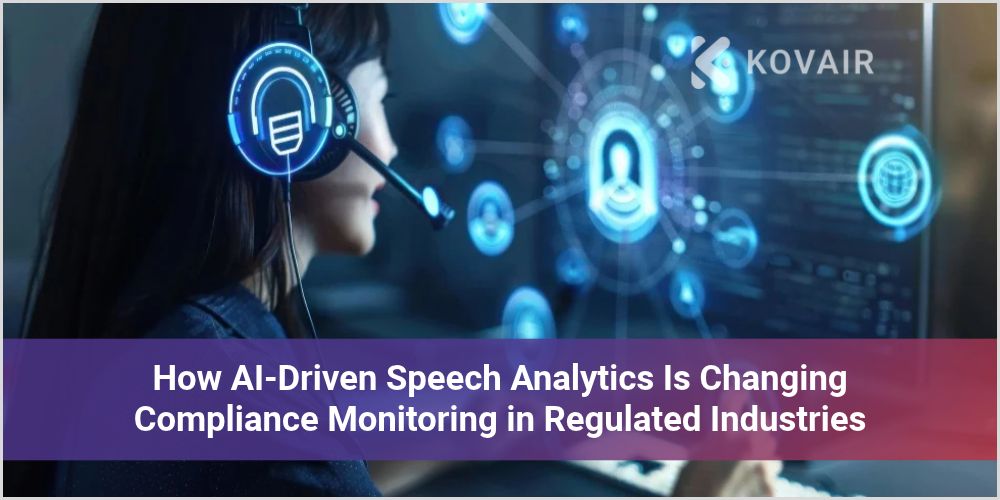
Traditional speech analytics has always helped to detect these signals by analyzing customer conversations. But when supervisors have to review millions of calls, the challenge is different. AI speech analytics helps here. It detects potential violations of rules by analyzing 100% of calls. This helps teams to understand and focus on risky conversations.
What does AI speech analytics mean, then, for compliance management? For agents and teams, it is just ‘following compliance’. CXOs must consider factors such as risks, trust, and growth.
Why the Sector of Regulated Industries is Turning to AI Speech Analytics?
As call volumes increase, old-fashioned monitoring is simply not good enough, and regulated firms are turning to AI speech analytics.
Manual reviews are still important. They allow teams to dig deep into conversations. But when teams review just 2–5% of calls, most conversations go unchecked. Some calls may not be reviewed for days. (Amplify AI)
Missed disclosures go unnoticed. Reviews get delayed. Compliance gaps grow.
Your team can use AI speech analytics to perform the following tasks:
- Get more coverage by receiving 100% of the calls.
- Identify risks earlier: Flag potential violations during customer calls.
- Save review time: Focus on calls that need attention.
- Stay consistent: Apply the same compliance rules across calls.
Market change is also clearly visible here.
According to PwC’s Global Compliance Survey 2025, 75 percent of companies use technology. 82 percent plan to increase investment in compliance technology.
(These figures reflect compliance technology broadly, not speech analytics alone.)
How Can Leaders Extract Compliance Intelligence Using AI-Powered Speech Analytics?
First, AI in speech analytics converts the customer call recordings into text. As a result, compliance teams can easily monitor statements that contradict policy or regulations.
Here’s a closer look at how it works:
- It starts with text conversion: speech-to-text conversion automatically converts recordings into text. It uses ASR technology for this conversion.
- It identifies who the speaker is: Separates agent responses from customer speech.
- It detects phrases related to compliance: Speech analytics finds keywords like missing disclosures and requests for sensitive data. It highlights them for easy identification by teams.
- It analyzes text with context: It uses NLP and AI models to understand the context of possible violations that traditional keyword matching will not catch.
- It gives alerts to teams: It provides a link with defective statements. Supervisors can now listen to audio and transcript line by line.
How AI Speech Analytics Makes Compliance Monitoring More Proactive
AI-driven speech analytics changes how teams identify, review, and manage compliance risks. But the impact varies by level of the organization.
| Organizational level | What changes? | Business impact |
| Contact Center Agent | Real-time speech-to-text and keyword detection can alert agents to a missed disclosure or potentially non-compliant statement during a call, if any. | Agents can correct customer issues while the conversation is happening. Not after the call has ended. |
| Team Leader | Scorecards and dashboards help supervisors to understand high-risk calls. They also show repetitive issues across agents. | Managers can use live suggestions for personalized coaching. It focuses on specific compliance gaps rather than random call reviews. |
| Compliance Analyst | Context analysis and call transcript checks determine whether agents have violated the rules. They locate the exact part of a call. | It reduces the time of manually checking each and every call recording. Analysts can also validate detected issues in less time. |
| Compliance Leaders | AI speech analytics gives insights about weak controls. Checks which corrective action is taken. Determines where further intervention is needed. | |
| CXO | Risk dashboards aggregated at a higher level provide a view of compliance trends and remediation progress. | Better alignment of executives with business exposure and the areas where compliance efforts need to be focused. |
Finding Enterprise-wide Risks Through Individual Conversations
A single conversation has the ability to reveal compliance gaps. But what is really interesting is to know how compliance information moves through the organization. Speech analytics detects potential issues in individual conversations. Teams can now decide where strong controls are needed.
Tip: AI Speech Analytics can easily find risks in compliance. But it is unable to confirm violations on its own. Human intervention is equally important. For that, enterprises must have clear escalation procedures. They must quickly take corrective action.
Cutting Compliance Risk: AI Speech Analytics in Telecoms and Other Regulated Industries
Case studies from around the world of AI helping regulated firms enhance call monitoring and spot potential compliance breaches.
- Banking: Increased Communications Monitoring
Challenge: A large brokerage and banking company required a solution to monitor trader communications on multiple channels.
AI solution: Infosys used NICE Actimize Communications Surveillance. It applied the technology to conversations from speech, emails, and chats. Detects elements of actions, communication, and policy violations.
Results: Increased compliance analysts’ performance by 80% and reduced false-positive alerts by 45%.
- Insurance Auto Call Reviews
ICICI Lombard also manually screened 20 percent of customer calls.
How did the company use speech analytics?: Custom NLP algorithm with Azure Speech Services and speech-to-text AI from the insurer. It also detects insurance-related keywords. It then follows the process of language conversion – either Hindi to English or vice versa.
Results: 100% call review; QA percentage changed from 50 % to more than 80 %.
Benefit: Teams could identify maximum compliance gaps.
- Telecoms – Better Call Monitoring
The problem: A large US telecom company was reviewing calls manually in search of a limited view of compliance risk.
Solution: VoiceTRACK used Provana’s speech analytics platform to automate call monitoring and quality.
Results: 99% compliance score and over 50% fewer call regulatory violations across three agencies.
Benefit: Automated monitoring allowed for more oversight than possible with limited manual samples.
- Life sciences: high-risk calls first
Problem: Large life sciences company required scaling of patient service conversation monitoring.
AI solution: Authenticx targeted its speech analytics engine toward call recordings and used predictive analytics in order to identify calls likely to have compliance-related content for more in-depth human review.
Results: 50% decline in compliance issues and a 45% increase in total calls.
Advantage: Teams could solve issues more efficiently. They could also prioritize high-risk interactions.
Industries-wise AI Speech Analytics Readiness Partner Scorecard
| The Industry | What Technical Heads Need to Assess | What CXOs Need to Consider | Risk of Non-Compliance |
| Banking and Finance Sector | Regulations, including issue detection, audit data, data encryption, and integration with surveillance systems. | Legal penalties. Reputational damage. | High |
| Healthcare | Security of conversations, keeping patient data private, and checking access controls. | Patient confidentiality. Damage to reputation. | High |
| Insurance | Speech recognition related to terms used in insurance, consent tracking, and policy compliance checks. | Mis-selling. Customer complaints. Legal regulatory action. | High |
| Telecommunications | Handling high call volume, alerting customers, and recording controls. | Consumer protection obligations. Complaint trends. Potential penalties. | Medium–High |
| Life Sciences | Conversation classification, secure data management, and adverse event escalation processes. | Product liability. Patient safety. | High |
Compliance risk ratings are indicative, not universal. Actual risks depend on the internal organizational regulations, related activities, and controls.
Never Wait till Your Compliance Fails
Finding out compliance gaps in regulated industries is indeed critical. AI speech analytics services are an optimal option for enterprises to better find compliance intelligence. The choice is yours. Can you wait for traditional ways of compliance monitoring? Or would you simply invest in AI for better insights and better business growth?

Mila Rowe

Mila Rowe is a technology writer passionate about digital transformation, AI, and enterprise innovation. She simplifies complex ideas into actionable insights for modern businesses.