Ask an engineering team a simple question. Which of last quarter’s commits did a person write? Which came from a model? Most teams cannot answer with confidence. That gap is now a real problem. It affects application lifecycle management. ALM tools depend on an audit trail. That audit trail was never built for AI-assisted commits. It is starting to break.
The Assumption Every ALM Tool Makes
ALM tooling runs on one core assumption. Every commit traces back to something: a requirement, a ticket, or a defect record.
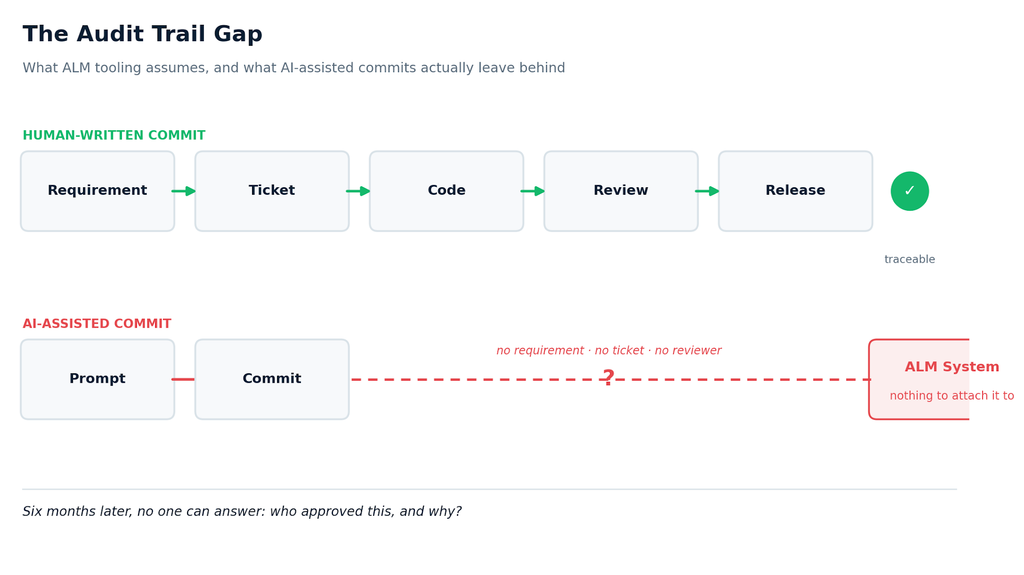
That holds when a developer reads a ticket. They write the code. They link the commit to the ticket ID. The chain is clean: requirement, decision, code, review, release.
Auditors rely on this chain. So do compliance teams. So do security reviewers. So does anyone trying to work out why a change happened. Even six months later.
How AI-Assisted Coding Breaks That Chain
AI-assisted coding does not follow that chain. It follows a prompt.
The prompt is where the real decisions happen. What to build. What limits to set. Which edge cases to cover. Prompts rarely get logged near the commit. Many teams squash a long AI session into one commit before merging. The reasoning in between disappears. So do the rejected approaches. So do the fixes a developer made to the model’s output. All of it is gone.
What is left is a commit message that says “add validation logic.” There is no trace of the prompt behind it. No record of what the developer checked. No note on why this approach won over another. The rationale is gone, even though the code remains.
There is also a structural mismatch. A human writes code at the speed tickets get filed. A model proposes changes faster than tickets exist. Generation outruns the requirement pipeline. Commits start landing that no requirement ever described. The ALM system has nothing to attach them to.
Where This Fails in Practice
The gap shows up in specific ways during audits and incident reviews.
Unexplained commits in a compliance review. A commit touches sensitive data logic. Nothing explains why.
Dead ends in incident response. A production issue traces to a commit. Nobody can tell if it was AI-made, human-made, or a blend.
Requirement drift. The ticket describes one thing. The code does something broader. No one flagged it.
Skipped review gates. Code gets merged after a quick glance. Subtle logic flaws slip through.
Gaps in regulatory logs. SOC 2 and ISO 27001 expect years of change records. That applies when a system makes automated decisions. A 30-day CI/CD log rotation does not meet that bar.
Any one of these can turn a routine audit into a weeks-long rebuild of history.
CVE-2025-48757 Shows What an Untraceable Change Costs
This is not hypothetical. In May 2025, security researchers Matt Palmer and Matan Getz disclosed CVE-2025-48757. More than 170 production apps built with an AI coding tool shipped with one flaw. Database row-level security was switched off. Any unprotected table returned every row to anyone who asked. No login. No exploit. One HTTP request.
The root cause was not one bad decision. It was a missing one. The AI tool’s code generation scaffolded a working database schema. Enabling row-level security was not part of that output. Nothing at deploy time flagged the gap. Whoever reviewed the resulting commits, if anyone did, saw no signal. A step had been skipped. There was no ticket asking for it. There was no reviewer confirming it was on. The chain this article has been describing simply was not there.
Launch Ready Code’s postmortem breaks down the exact request that returned full database contents. It also covers the three-line fix that would have closed the gap before it shipped.
Making AI Involvement Machine-Readable
The fix is not a new tool category. It means making AI’s role a clear, machine-readable fact. Put it in the metadata you already have. Git has supported this for years, through commit trailers. These are structured key-value lines at the end of a commit message:
AI-Assisted: yes
Generated-By: <assistant name and version>
Prompt-Ref: <link to the PR comment or design note holding the prompt>
Ticket: PROJ-1234
Trailers are parseable by git interpret-trailers. They are greppable in history. ALM tools can read them too. AI involvement can sync onto the requirement record itself. It does not have to live only in Git. Once the convention exists, enforcement is mechanical:
A commit-msg hook or commit lint rule can reject bad commits. Any commit with code changes needs a Ticket trailer and an AI-Assisted trailer.
A server-side pre-receive check, or a required CI status, enforces the same rule centrally. Laptops that skip the hook cannot push around it.
A drift check in CI compares the changed-file scope against the ticket’s component tags. It flags mismatches. This is a cheap way to catch a model that went beyond the ask. Authentication, payment, or data-access paths need a matching ticket scope. Without a match, the merge should block, not warn.
Process Fixes That Complete the Chain
Log the prompt with the pull request. Store the prompt, or a summary of it. Use a PR comment or a linked design note. Treat it like a design decision record, because it is one.
Add a real review gate for AI diffs. Require a named reviewer to confirm they read the generated code. Not the diff summary alone. That review is not redundant. It is the only human decision left in the chain.
Split “generated” from “verified.” Compiling and passing tests are not enough. Mark it verified only once a human confirms the logic matches intent. The trailer can carry that status.
Align retention with the regulatory clock, not the CI default. Export PR conversations and prompt logs to storage with a multi-year retention policy. CI logs rotate in days. Audit obligations run in years.
The Short Takeaway
ALM traceability was built around human decisions. AI-assisted development adds a new decision point: the prompt. Most pipelines never capture it. Generation now outruns the ticket pipeline the tooling assumes.
CVE-2025-48757 did not happen because someone made a bad call. It happened because no one could see that a call had been skipped. Commit tags, prompt logs, and a real review gate close that blind spot before it ships. The alternative is a regulator, an auditor, or 170 exposed databases finding it first.
Jai Mittal is the founder of Launch Ready Code, a fractional CTO service for AI-built applications. He audits and hardens apps before and after launch. He works directly with founders shipping fast on AI coding tools, closing the gaps that speed introduces.
Mila Rowe

Mila Rowe is a technology writer passionate about digital transformation, AI, and enterprise innovation. She simplifies complex ideas into actionable insights for modern businesses.