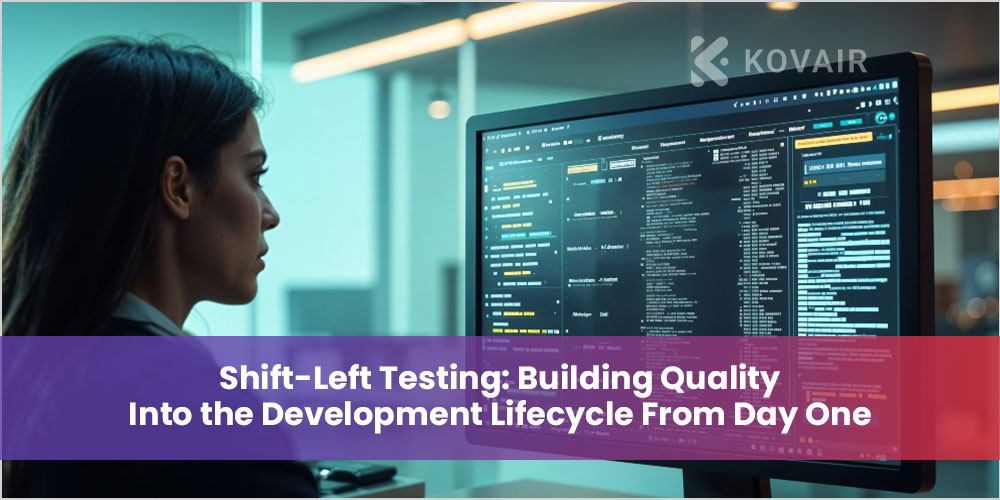
Sprint velocity metrics often look healthy right up until the final week of a release cycle. Features zip across task boards, code builds pass compilation tests, backlogs diminish. Then projects go into a stability phase, a multi-week freeze for manual verification and late-stage regressions.
Development slows, defect tickets pile up in the issue trackers, and engineers go from designing features to triaging production blocks.
This delivery bottleneck results from seeing quality verification as a detached downstream gate. Engineering leaders remove this barrier by shifting testing left, bringing automated validation, continuous verification, and end-to-end lifecycle traceability into earlier development stages.
Why Downstream QA Fails Modern Release Cycles
In conventional delivery methods, validation of quality is done after code compilation and packaging. The sequential approach generates certain operational risks:
- High Context Switching Costs: If a bug appears weeks after the original code was created, a developer has to stop what they’re doing in the current sprint, get back into the headspace, and follow the reasoning they wrote weeks ago.
- Disconnected toolchains: Developer contributions, unit test runs, and QA defect tickets sometimes exist in isolated silos, limiting insight into test coverage.
- Escalating Remediation Expenses: Resolving an ambiguous business rule during sprint grooming requires a simple user story update. That similar problem in production leads to emergency hotfixes, database rollbacks, and unscheduled downtime.
| Stage of Discovery | Relative Cost to Fix | Lifecycle Impact |
| Requirements / Sprint 0 | 1x | Instant documentation update |
| Development / Unit Stage | 10x | Fast local code fix by the author |
| Integration / CI Build | 20x – 30x | Automated pipeline failure; quick branch triage |
| Production | 60x – 100x+ | Emergency patch cycles and operational disruption |
The Mechanics of Shifting Left: Quality as an Ambient Discipline
Moving testing upstream doesn’t imply asking developers to conduct manual UI tests. Shift-left testing re-organizes validation processes in all phases of delivery.
Static Validation and Requirements Traceability
Quality engineering starts before developers create application code. QA engineers and product managers write clear acceptance criteria in BDD forms.
An integrated ALM repository establishes links between user stories, test cases, and their execution results to provide for bidirectional traceability. This relationship assures test coverage of each criteria and is vital for regulated enterprises and compliance audits.
Developer-Led Unit and Contract Checks
Component accuracy is owned directly by developers. We have extensive unit test suites to validate the local logic before we submit a pull request. API contract tests ensure schemas are adhered to across microservice architectures, removing the need for complex, heavy end-to-end integration environments.
CI/CD Pipeline Testing and Toolchain Orchestration
A sustainable early-validation framework connects test suites directly to automated build workflows. Modern CI/CD pipeline testing creates structured validation gates on every commit:
- Static Analysis: Code quality scanners inspect syntax standards and flag anti-patterns on pull request creation.
- Automated Unit Suites: Fast, isolated checks run alongside code coverage thresholds.
- API Validation: Automated contract and smoke tests verify service boundaries across ephemeral test environments.
- Security Integration (DevSecOps): Software Composition Analysis (SCA) and Static Application Security Testing (SAST) run early, catching vulnerable dependencies before code merges into release branches.
Automating these steps establishes continuous testing, giving cross-functional teams immediate, objective feedback on build readiness.
Bridging Tool Silos: Dev, QA, and DevOps
Modern engineering organizations increasingly incorporate machine learning to optimize early testing workflows:
- Predictive Test Selection: Machine learning algorithms analyze code diffs on pull requests and run just the test suites that are impacted by changed files, thus decreasing build times.
- Synthetic Test Data: On demand, automated systems generate privacy-compliant test data sets to resolve data conflicts in the test environment.
- Smart Failure Classification: Machine learning approaches intelligently categorize build failures and separate real regressions from environmental flakiness.
Keeping pace with intelligent automation trends helps teams build resilient delivery pipelines. Discover more on these advancements in this detailed analysis on emerging AI patterns in software testing.
Implementing an Early Quality Roadmap
Engineering teams can adopt an early-testing approach by rolling out systematically:
- Create Quality Baselines: Use pre-commit hooks, static linting rules and required unit coverage goals.
- Automated Pipeline Integration: Implement automated test automation suites and API tests as blocking gates within CI/CD processes.
- Synchronize Lifecycle Traceability: Link automated test results directly to requirement management systems to help assure thorough coverage.
- Security Shift Left: Automate vulnerability scans and container inspections earlier in pull requests
- Optimize Feedback Loops: You can keep track of build durations, isolate failing tests and run tests in parallel.
Building a Resilient Quality Culture
Moving quality upstream means you don’t get surprise deployment freezes; you get regular, consistent releases. An organized and disciplined agile testing strategy with resources dedicated to full software quality assurance allows engineering teams to find bugs early, fulfill deadlines, and deliver excellent software for enterprise-scale operations.

Kanika Vatsyayan

Driven by a passion for quality, Kanika Vatsyayan is the Vice-President of delivery and Operations at BugRaptors, overseeing all quality assurance initiatives. With over 10 years in the IT industry, Kanika brings a wealth of experience in test leadership and management across diverse sectors. She is committed to result-oriented, business-centric approaches and actively explores emerging technologies to optimize business models. Kanika is an experienced blogger, sharing her automation and manual testing expertise with a wider audience.