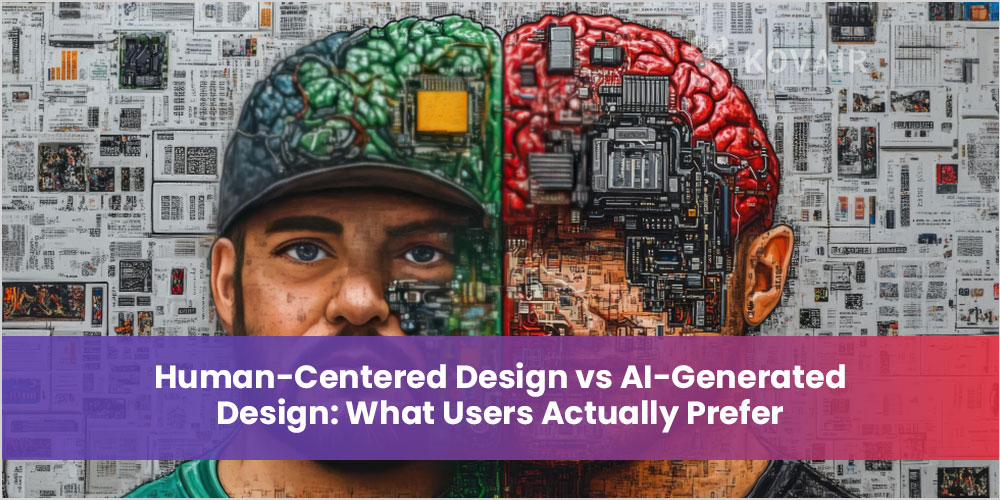
AI Transformation in Digital Experience Industry (2026)
In 2026, the digital experience industry is undergoing a profound transformation driven by iterations in artificial intelligence (AI) technology. AI tools can generate website layouts, product pages, user interfaces, graphics, and even full brand identities in a matter of minutes.
Boasting advantages of fast turnaround, low cost, and high scalability, these tools have been widely adopted by a full range of market players, including startups, e-commerce platforms, design agencies, and large brick-and-mortar enterprises.
At the same time, however, human-centered design—supported by designers with deep expertise in human psychology, emotional needs, accessibility design, user behavior, and usability research—remains the core pathway to delivering high-quality user experiences.
Core Industry Debate in 2026
The core controversy facing the design industry, namely whether users prefer human-centered design or AI-generated design, has a far more complex answer than surface-level observations suggest:
User Expectations in 2026
2026’s users no longer support offerings solely for their automated or visually eye-catching interfaces; they prioritize experiences that are intuitive, emotionally resonant, personalized, trustworthy, and easy to navigate. While AI is only capable of producing visually appealing, fast-generated layouts, users still favor designs that align with the authentic needs of human users.
This paper explores the differences between the two design approaches, their respective impacts on user experience, and the true preferences of users in 2026.
Human-Centered Design (HCD)
1. Definition and Core Philosophy
User-centered design, or human-centered design (HCD), has as its core the integration of users’ real needs across all stages of the design process.
2. Traditional Design Shift
It rejects the traditional design mindset of the past that prioritized serving system and algorithmic logic, sequentially outlines six core priority guidelines and six actionable research processes, and centers on the ultimate core goal of developing products that fit users’ actual usage scenarios.
AI-Generated Design in 2026
1. Definition and Capabilities
AI-generated design refers to all design-related content created partially or entirely by artificial intelligence systems.
2. AI Design Outputs and Data Processing
Mainstream AI design tools available in 2026 can generate 10 categories of design outputs, including website layouts and UX wireframes. These tools can analyze three core sets of data—user behavior, design trends, and performance metrics—to optimize layouts.
3. Automation in E-commerce Systems
Some tools can even automatically generate complete e-commerce stores, drastically cutting enterprises’ development timelines and operational costs.
4. Strategic Business Questions in 2026
In 2026, generative AI has fully restructured digital design workflows, and digital enterprises are facing four core questions: whether to replace human designers with AI, whether AI can understand human emotions, whether users trust AI-generated experiences, and whether automated design can sustain customer loyalty.
5. Impact on Digital Competition
As competition in digital commerce and online services grows increasingly fierce, websites that only offer visual appeal can no longer create competitive differentiation.
6. Business Performance Metrics Impacted
Users’ six core expectations, along with the ongoing debate between human-centered design and AI-generated design, directly impact four core business metrics: conversion rate, user retention, SEO, and long-term brand trust.
Why Human-Centered Design Dominates High-End Experiences
A. Psychology-Driven Design Advantage
This paper argues that the core reason Human-Centered Design has come to dominate high-end digital experiences is that it centers its focus on users’ psychology and emotions.
B. Emotional Intelligence in Design
Human designers’ ability to understand emotions outperforms that of AI, enabling them to create six types of positive experiences, including trust and excitement.
C. Industry-Specific Emotional Needs
This capability can meet the specific needs of different scenarios: medical websites require a sense of reassurance, while gaming platforms need an energetic atmosphere, which is a core advantage that AI does not currently possess.
Core Principles of Human-Centered Design
- User Pain Point Identification – The core of human-centered design is to identify real user pain points.
- Critical Question Framework – Senior designers dig deep into these pain points using four categories of critical questions.
- Limitations of AI Understanding Users – Current AI can only optimize existing models, and it cannot identify deep-seated behavioral problems without human interpretation.
- Brand Identity and Emotional Differentiation – To build a stronger brand identity, human designers can shape a brand’s unique personality.
- AI vs Human Creativity Difference – AI, which relies on pattern recognition and trend analysis, is prone to producing repetitive designs, while the core values that humans bring—such as unique visual recognition and emotional differentiation—are especially critical in highly competitive industries.
Accessibility and Design Ethics
- Accessibility as a Core Requirement – In 2026, accessibility will remain a core issue in the design field.
- Key Accessibility Areas – Human-centered designers must take into account five key accessibility areas, including those addressing cognitive impairments.
- Human Oversight in AI Systems – Even as AI tools continue to iterate and upgrade, the core role of human oversight remains irreplaceable.
Advantages of AI-Generated Design
- Speed and Scalability Benefits – Even though AI-generated design is not entirely flawless, its core advantages of speed and scalability can still deliver four categories of tangible implementation benefits to all types of business entities.
- Startup Optimization Focus – These benefits particularly align with the core needs of small and medium-sized startup groups, which prioritize efficiency and cost-effectiveness.
- Data-Driven Optimization – Centering on the core theme of Data-Driven Optimization, AI systems can analyze massive volumes of user behavior data.
- Optimization Categories – They identify four categories of implementable optimization directions and help improve quantifiable performance indicators.
- Real-Time Personalization – One of AI’s core advantages is real-time adaptive personalization.
- Data Sources for Personalization – It can draw on user behavior, device type, purchase history, geographic location, and browsing patterns to create large-scale, highly customized experiences.
Continuous Learning in AI Systems
- Machine Learning Adaptation – In the field of artificial intelligence (AI), Continuous Learning—referred to as persistent learning in Chinese academic terminology—relies on machine learning.
- Adaptive UX Optimization – It can automatically optimize interface layouts and interaction modes in response to changes in user behavior.
Hybrid Future of Design (2026 and Beyond)
1. Shift Toward Integrated Experiences
We predict that in 2026, users will not favor only a single design type, whether human-centered or AI-generated; instead, they will prefer integrated experiences.
2. Emotional vs Functional Design Gap
The authors of this paper propose that users respond more positively to experiences that feature authenticity and emotional perceptivity.
3. Emotional Gaps in AI Interfaces
Current AI interfaces are technically polished yet emotionally hollow.
4. User Interaction Values
Users prioritize four core interaction values, including human narrative.
5. Industry Sensitivity
This observed pattern is particularly critical for six industries involving emotion-related decision-making, such as healthcare.
AI in Consumer Services and UX Limitations
- Balance Between Emotion and Efficiency – This study finds that in AI consumer service scenarios, users both value emotional experiences and recognize the value of efficiency.
- Expected AI Functions – Consumers expect five AI functions to be available in 2026.
- Over-Optimization Problem – Our study finds that the core flaw of current AI-generated design is over-optimization.
- Key AI Design Weaknesses – They are one-size-fits-all, predictable, emotionally detached, and overly automated.
- User Trust and Engagement Decline – Most users can already recognize this templated experience.
Trust and Ethics in UX (2026 Priority)
- Trust as Core UX Metric – We judge that one of the highest-priority focus areas for the user experience industry in 2026 is trust.
- Elements of Trust – Users increasingly favor transparency, human oversight, ethical AI, and authentic communication.
- Role of Human-Centered Design in Trust – Human-centered design serves as the core support for building this trust.
Human-AI Hybrid Design Models
1. Collaboration Over Replacement
Successful business entities in 2026 will no longer make either-or decisions between human capabilities and artificial intelligence (AI).
2. Division of Roles
AI will take charge of repetitive optimization tasks, while human designers focus on strategy, empathy, and narrative creation.
3. Evolution of Designer Roles
Previously, the industry predicted that AI would phase out human designers.
4. Future Skill Focus
They must focus on six core areas, as the value of human creativity in creating meaningful digital experiences is irreplaceable.
AI in E-commerce Systems
AI Use Cases in E-commerce
This paper’s review finds that e-commerce platforms are the core adopters of AI-generated design systems.
Five Key Applications
AI can assist with tasks across five major scenarios: product page generation, intelligent recommendation, dynamic pricing display, personalized homepage layout, and automated product merchandising.
Need for Human UX Principles
However, successful e-commerce operations still cannot function without human-led, human-centered UX principles.
PrestaShop Example
For example, the custom HTML boxes of PrestaShop still require designers to optimize navigation and trust elements to deliver tangible improvements to user experience.
SEO and Ranking Impact
1. Search Engine Updates in 2026
In 2026, major search engines, including Google, adjusted their ranking weights, incorporating six core evaluation factors such as user satisfaction and content quality.
2. SEO Risks of AI Design
AI-generated designs that neglect user experience will face poor SEO performance.
3. Performance Improvements from HCD
Human-centered design can optimize five metrics, including dwell time and navigation clarity, effectively lifting the search ranking of its associated website.
Limitations of AI Design Systems
- Emotional Depth Limitation – Despite the rapid development of current AI design systems, designs generated entirely by AI still face core limitations in their capabilities.
- Lack of Emotional Intelligence – The most prominent limitation is a lack of emotional depth.
- Homogenization Problem – Against the backdrop of prevailing generic design patterns, AI relies excessively on existing trends and datasets.
- Impact on Branding – This leads to homogenization and weakens brand differentiation.
Ethics, Accessibility, and Human Oversight
a. Ethical Concerns in AI Design
Users are growing increasingly vigilant against AI-driven manipulation.
b. Ethical Risk Categories
Four categories of ethical concerns have emerged.
c. Accessibility Verification
AI without specialized training and oversight is prone to missing accessibility requirements.
d. Role of Manual Review
Manual review serves as the core safeguard for inclusive design.
Emotional Experience Design Principles
1. Core Purpose of Digital Design
This paper proposes that the core of digital design is to serve people.
2. Five Emotional Outcomes
It identifies five types of positive experiences: being understood, comfort, autonomous empowerment, being inspired, and being valued.
3. Emotional Needs in UX
Human-centered design succeeds by prioritizing emotional fulfillment.
4. AI Limitations in Emotional Design
Even advanced artificial intelligence (AI) requires human guidance to create experiences that resonate with users.
Human-AI Collaboration Framework
- Collaboration in Business Scenarios – We propose that human-AI design for business scenarios adopts a collaborative rather than a replacement approach.
- Task Scenarios – It covers five types of task scenarios and improves scalability and productivity.
- Division of Labor in UX – This study proposes a specification for the division of labor between humans and machines in UX design.
- Strategic Control by Designers – Human designers must lead five core strategic tasks and maintain control over the design’s core value.
- Feedback and Testing Systems – This study proposes that user feedback be collected as a priority.
- Risk of Data Over-Reliance – Four categories of problems must be tested, and a cognitive misconception of relying solely on data must be avoided.
Future of Digital Design (Post-2026)
1. Shift Toward Deep Collaboration
Design must center on authenticity and avoid overly mechanized experiences.
2. AI Capability Expansion
AI will undertake automation, optimization, personalization, and predictive analysis tasks.
3. Human Creative Roles
Human designers will focus on creativity and empathy.
4. Human Value in Design
AI will not replace humans; it will only empower creativity.
5. Brand Success Strategy
Future successful brands must integrate technological efficiency with authentic humanistic understanding.
Final Analysis – Hybrid Design is the Future
For a long time, the industry has widely regarded human-centered design and AI-generated design as mutually exclusive, opposing options. In reality, the two are never a black-and-white either-or choice.
Drawing on the 2026 user preference trend data we have tracked, users’ core demand for composite experiences has clearly emerged: AI-generated design boasts four major advantages: high speed, strong scalability, high levels of personalization, and dynamic optimization capabilities, which enable it to effectively empower all types of enterprises.
Yet AI cannot satisfy users’ demand for authentic, emotion-driven experiences. Only human-centered design can address the user’s emotional, psychological, and behavioral dimensions that AI is unable to replicate.
Hybrid collaborative practice is the future of design, and this model can be implemented in SaaS platforms, mobile applications, and e-commerce stores integrated with custom HTML modules.
In the final analysis, humans have always been best equipped to design for humans.



Mila Rowe

Mila Rowe is a technology writer passionate about digital transformation, AI, and enterprise innovation. She simplifies complex ideas into actionable insights for modern businesses.