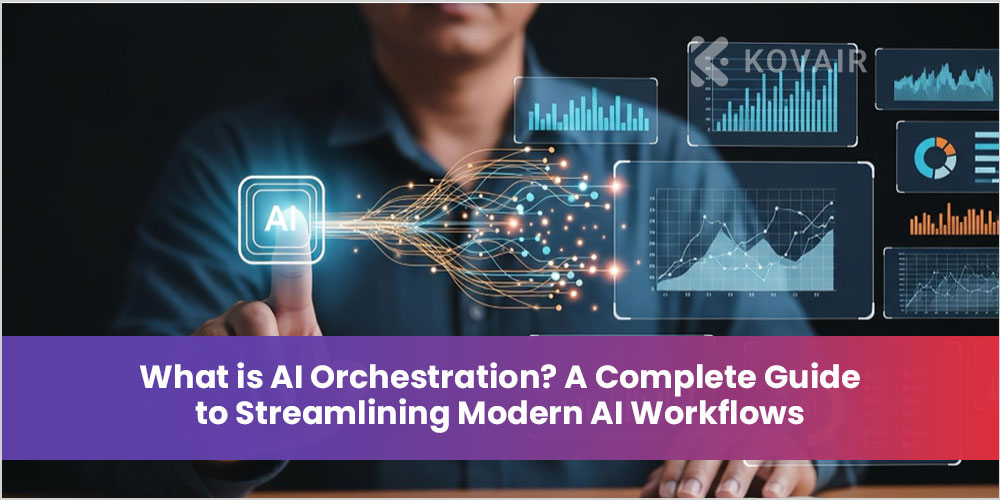
Imagine you pay a subscription for television where you get access to all OTT premium channels from Prime, Netflix, and Disney+. Similarly, AI Orchestration works by coordinating and managing multiple AI models, autonomous agents, data sources and software workflows to work together seamlessly.
It helps accelerate problem solving, seamless scalability, intelligent automation and much more. In this article, we have explained in detail about streamlining modern AI workflows.
Key Facts:
- AI orchestration market size is valued at over $36 billion and is going to skyrocket to $122.5 billion by the end of 2033.
- According to IBM, enterprises that use orchestration for governance are 13X more likely to successfully scale AI beyond small pilot projects.
- AI orchestration data provider that bridges the gap between static training models and live production code.
- 60% of organizations worldwide expect generative AI and orchestrated tools to primarily result in improved efficiency and cost reduction.
- Over 20% of global enterprises report scaling agentic AI systems coordinating multiple agents to execute complex and real-world workflows.
What is AI Orchestration
AI orchestration is the connected, end-to-end application of AI tools, agents and automation across workflows, teams and systems. It uses structured logic and adaptive intelligence to decide which tool should act, when and how, so your business runs faster without losing control.
Outdated AI deployments often create hassle, even if your chatbots do not know what they are actually doing and your data analysis tool cannot share insights with your automation platform.
Managing all models in one is incredibly complex. With proper AI orchestration, previously isolated AI tools and workflows communicate with each other, share data, and work together toward common goals. It is more like when you bring your parents to coordinate like an adult, rather than relying on messaging between them like some kind of emotional support carrier pigeon.
Have you ever wondered what an AI orchestration platform does? Here we have listed some of the best functional activities it supports in doing;
- Analyze the content
- Determine the sentiment
- Prioritize based on the customer’s history and value
- You can either resolve it automatically or route it to the right human with context-aware suggestions
How AI Orchestration Works
Below, we have explained a step-by-step process of how AI orchestration works;
Receives the User Request
The process is when a user submits a request through a chatbot, application, or an enterprise platform. This can include anything from generating a report to automating customer support or analyzing data sets. For example, if you run a pharmacy store, you analyze last month’s sales and send a summary to the management team.
Understands the Intent
The AI orchestrator understands the user intent, using natural language processing. It identifies tasks, objectives and prepares an execution plan. Rather than treating the request as one large task, it divides it into smaller, manageable steps.
Assigns Tasks to Specialized AI Agents
Once the workflow is planned, the orchestrator delegates each task to the most suitable AI agent or model.
For example, an analytics AI identifies trends and insights, and an automation tool emails the report to stakeholders and owners.
Connects with Enterprise Systems
To complete the workflow, the orchestrator integrates with existing business tools and data sources through APIs. These include CRM platforms, ERP systems, Cloud databases, Slack, Salesforce, and third-party applications.
This allows AI agents to access real-time information and perform actions within existing business environments.
Coordinate the Workflow
The orchestrator manages the entire workflow between AI agents, ensuring each task is completed in the correct sequence.
If one task relies on another, the orchestrator waits for all before steps to be completed before moving forward.
What all does it handle;
- Error management
- Workflow optimization
- Handles retires
Validates the Results
Here, the orchestrator performs an analyst’s checker role, where it reviews the generated results for completeness and accuracy.
What all does it handle:
- Verify data consistency
- Remove duplicate information
- Check formating
- Request additional processing if needed
This quality helps improve reliability and reduce errors.
Delivers the Final Output
Once all tasks are done and completed, the orchestrator provides the final result to the user. Their output may be;
- A business report
- A chatbot response
- A generated document
- A completed workflow
- A dashboard update
This all process takes place without any human intervention and zero error.
AI Orchestration Vs related concepts
We do not say AI orchestration is all you need. There’s a lot of overlap, so let us break down how AI orchestration differs from some similar-sounding concepts.
AI Orchestration vs Traditional Apps
AI orchestration handles users’ queries to a specialized problem-solving AI, which impacts automation workflows, like pitching an email, solving customer queries, and updating their accounts.
While traditional apps are designed to perform specific tasks like customer support guidance, recognize an image what type of picture it is. Simply traditional apps only do what you ask for. Because they do not have brains like humans.
AI Orchestration vs. MLOPs
MLOps manages the lifecycle of individual machine learning models, like managing the Claude model at a time. This includes model development, deployment, monitoring, and maintenance. It operates at a lower technical level, focusing on the specific steps within ML processes.
AI orchestrations are known for handling a broader view. It coordinates complex, multi-systems AI workflows that include multiple ML models along with other components like AI agents, RPA tools, APIs to external services, databases and so on.
AI Orchestration vs. AI agents
AI is an individual, autonomous system that performs specific tasks. It’s a self-contained entity with its own goals, capabilities and limitations. Think of a customer service chatbot, an autonomous drone, or a virtual assistant like Siri and Alexa.
AI orchestration, in contrast, creates the systems that allow different AI agents to communicate, share information, and coordinate their activities toward common goals.
What are the benefits of AI Orchestration
Let’s look at some of the top benefits of AI Orchestration;
End-To-End Workflow Automation
It enables AI models to run multi-step operations without any human intervention.
Example;
- An automation tool helps to send emails to clients and stakeholders
- Analyzing text and responding to it accordingly
Enhanced Scalability
Orchestration platforms dynamically distribute computing resources to handle fluctuating demands, scaling up during busy periods and reallocating resources once workloads normalize.
Operational Visibility
Leaders gain better real-time insights into AI usage, task costs, and performance, which helps eliminate duplicated tools and AI sprawl.
Optimized Resources
By automating end-to-end workflow operations the things which are going to impact positively is you do not need to spend much operational costs, speed up decision-making, and you can deploy the tasks in a week rather than spending a month or a year.
Reliable Governance & Security
It adds a centralized control layer where teams can enforce role-based access, tool permissions, and adult traits to keep autonomous agents compliant with internal policies.
Maximize ROI & Reduce Sprawl
By providing centralized monitoring, leaders gain deep visibility into model performance, latency and operational cost, helping prevent duplicated tooling.
Examples of AI Orchestration
Let’s understand AI orchestration with a few examples to make you feel easier and understand and clear your doubts;
- Dynamic Ride-Sharing (Uber): Multiple AI models handle multiple tasks at a time, from bridging the gap between drivers and riders through chat, calls, and adjusting demand, and sharing real-time location.
- Healthcare Patient Pathways and Diagnostics: Orchestration enables computer vision and natural language processing models to scan and summarize physical documents, analyze incoming patient referrals, extract key data, and apply scheduling and compliance rules.
Final Thoughts
As AI adoption continues to grow, businesses need more than standalone AI tools; they need intelligent coordination. Enterprise AI orchestration brings together AI Workflow Automation, Generative AI Orchestration, and AI Agent Orchestration to create seamless Enterprise AI workflows. By managing Multi-Agent AI Systems, or scalable Enterprise AI Workflows, professional AI Development Services can help you design, integrate, and optimize AI solutions that deliver measurable business value. Improving AI Pipeline Management and leveraging modern AI Automation Platforms, organizations can simplify AI workflow management, optimize every AI automation workflow, and achieve faster, more scalable results. In short, AI orchestration is the foundation for building smarter, more connected, and future-ready AI operations.
Mila Rowe

Mila Rowe is a technology writer passionate about digital transformation, AI, and enterprise innovation. She simplifies complex ideas into actionable insights for modern businesses.